

The Hidden UX Mistakes Costing Caribbean Resorts Thousands in Revenue
Imagine a traveler sitting in a rainy office in London or a cold apartment in New York. They dream of the sun, the sand, and the clear blue waters of the Caribbean. They spend hours looking at beautiful pictures of infinity pools and palm trees. They finally find your resort and think, "This is the one."
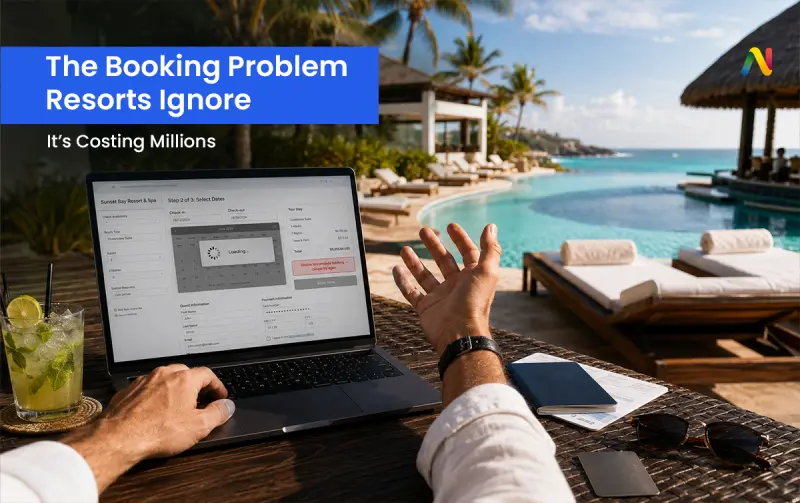
But then, the trouble starts. They try to book a room on their phone, but the calendar won't open. They try to see the price, but the page takes forever to load. Frustrated, they close your site and go to a big travel website like Expedia. At that moment, you just lost thousands of dollars in profit.
The Caribbean offers the world's best luxury. However, many digital storefronts are stuck in the past. This gap between a five-star resort and a one-star website is driving guests away. As a top hospitality website design agency, we see this every day. We help resorts stop this "revenue bleed" by making the digital journey as smooth as a tropical breeze.
Turn Your Resort Website Into a Better Booking Experience
Create a faster, clearer digital journey that supports direct bookings.
Let’s identify the UX improvements that matter most to your resort.
Discuss Your WebsiteThe True Cost of Poor UX: The Direct Booking vs. OTA Battle
When you own a resort, you want to keep as much of your money as possible. But when guests book through Online Travel Agencies (OTAs), they take a big piece of the pie. These sites can charge between 15% and 25% for every booking. If a guest spends $5,000 on a week-long stay, you might have to pay $1,250 to the OTA.
This is the "OTA Trap." These sites are good for showing your resort to the world, but they are expensive. Many guests find you on an OTA and then visit your official site to see if they can get a better deal or more info. This is your chance to win them over. If your site has a great direct hotel booking strategy, you keep that 25% for yourself. If your site is hard to use, they go back to the OTA, and you lose money.
Why visitors leave your site to book on Expedia (The 20% margin killer)
Why do people leave a resort's website? It is usually not because they don't like the rooms. It is because the website is too much work. Why do guests abandon hotel booking websites? The answer is "friction." Friction is anything that slows a person down.
When a guest visits your site, they want to feel safe and excited. If the site looks outdated, they worry about the safety of their credit card. If they can't find the "Check Availability" button, they get annoyed. These small UX mistakes on hospitality websites act like a "Keep Out" sign for wealthy travelers. They go back to Expedia because Expedia is easy and familiar. By not fixing your site, you are paying a "frustration tax" to the OTAs.
The psychology of the luxury traveler: Trust, speed, and elegance
People who stay at luxury resorts value their time. They are often busy professionals who want a stress-free vacation. They expect the website to be a preview of the resort. If the website is slow and clunky, they assume the resort will be disorganized too.
To win these guests, you need user-friendly navigation and clear CTAs. They shouldn't have to guess where to click. Everything should feel elegant and high-end. A resort website development company focuses on building that trust from the first second. When the digital experience feels like a luxury concierge service, guests feel confident enough to book directly.
Build Your Resort Website Right From the Start
Avoid costly UX problems before they become booking barriers.
Create a mobile-first experience designed around your guests.
Start Your Project3 Fatal UX Mistakes on Luxury Resort Websites
You might think your website is fine because it looks pretty on your office computer. But your guests are not in your office. They are on trains, in coffee shops, or lying in bed using their phones. Here are the three "hidden" mistakes that kill your sales.
Mistake 1: The mobile date-picker disaster
Most travel research, nearly 70%, happens on mobile devices. If your booking calendar is hard to use on a smartphone, you are losing most of your potential guests. This leads to a very high mobile booking abandonment rate.
We have all been there. You try to click "June 12th," but your thumb hits "June 11th" because the buttons are too small. Or, you have to zoom in to see the dates. This is a disaster for a luxury brand. When you hire Caribbean web developers, they should focus on a "mobile-first" design. This means the calendar should be big, responsive, and easy to tap. If a guest can't pick their dates in three seconds, they will leave.
Mistake 2: Lethal load times from unoptimized 4K drone videos
Everyone loves drone footage. It shows the scale of the resort and the beauty of the ocean. But there is a trap. If you put a massive, high-definition video on your homepage without shrinking the file size, your site will be slow.
In the Caribbean, Wi-Fi can sometimes be spotty for guests. Even in big cities, people don't want to even wait for 10 seconds for a page to load. Speed is a Core Web Vitals metric for image-heavy sites. Hence, if you identify that your site is slow, then it is certain that Google will rank you lower in search results. This makes your Caribbean resort's digital marketing much less effective. You need a UX design agency for luxury resorts that knows how to showcase your beauty without slowing down your operations.
Mistake 3: The "Insecure" redirects to a third-party site
This is the "Disjointed Handoff." A guest finds a room they like on your beautiful site. They click "Book Now." Suddenly, they are sent to a completely different-looking website with a weird web address.
This screams "insecure" to a guest. They wonder if they are on a scam site. It breaks the "digital trust" you worked so hard to build. To fix this, you need a seamless booking and checkout experience where the guest never feels like they left your brand. Every step of the booking should look and feel like your resort. This is why a hotel booking engine UX must be consistent from start to finish.

The Tech Stack: Architecting a Frictionless Booking Engine
The "engine" is the heart of your website. It is the software that collects the guest's information and communicates with your hotel's computer system. If the engine is old or poorly connected, your business will suffer.
Custom PMS API integration (Oracle Opera, Mews, Cloudbeds)
Your Property Management System (PMS) is where you keep track of all your rooms. To have a great website, the site needs to "talk" to the PMS perfectly. This is called PMS API integration (Opera, Cloudbeds).
When a guest looks for a room, the website should show exactly what is available right then and there. If the system is slow, a guest might book a room that was just taken by someone else. This causes a huge headache for your staff. By hiring a hospitality website design agency that understands how to connect these systems, you ensure everything stays in sync. This tech enables you to build high-converting landing pages that display real-time deals.
Why do you need to hire hotel tech developers?
A regular web designer might know how to make a site look good, but they don't know the "pipes" of the hotel industry. Building a site for a resort is much harder than building a site for a local shop. You need to hire hotel tech developers who understand room rates, taxes, seasonal changes, and loyalty points.
They can develop a custom booking engine plan tailored to your specific needs. Consider offering a free spa treatment for direct bookings. A custom engine makes that easy. A cheap, "off-the-shelf" system usually can't do that.
The ROI of Upgrading Your Resort's Digital Infrastructure
Many owners worry about the cost of building a custom hotel booking engine. But you have to look at the "Return on Investment" (ROI). Think of it this way: how much is a 25% commission worth over a whole year?
Not Sure Why Guests Aren’t Booking Directly?
Your website may be creating friction you cannot see internally.
Let’s look at the journey from a guest’s perspective.
Talk Through My WebsiteHow to increase direct bookings for Caribbean resorts?
If you improve your website's hospitality conversion rate optimization (CRO) by just a tiny bit, the results are massive. Let's say 1,000 people visit your site. If only 10 people book directly, that is 1%. If you fix the UX and 20 people book directly, you have doubled your direct revenue without spending a penny more on ads.
This is the secret of how to increase direct bookings for Caribbean resorts. You don't always need more visitors; you need to stop losing the ones you already have. A better website pays for itself very quickly by saving you from OTA commissions.
Why must you hire Caribbean web developers with hospitality expertise?
The Caribbean is a unique market. You need a team that understands the local vibe and the global traveler. When you hire Caribbean web developers, you get people who are in your time zone and understand your business.
The best website development company for luxury hotels is one that has a proven track record. They should be able to show you exactly how they have helped other resorts grow. They understand that a resort is not just a building—it is a dream that people save up for all year.
Conclusion: Stop Renting Your Guests, Start Owning Them
Every time a guest books through an OTA, you miss an opportunity to build a relationship with them. You don't get their email to send them a "Welcome" note. You don't know if they are celebrating a birthday. You are just a name on a list.
By investing in your own digital storefront, you take control. You show the guest that you care about their experience from the very first click. You save money, you build trust, and you grow your brand. It is time to stop the revenue drain and start owning your guest relationships.
Stop letting hidden UX mistakes cost you money. Your resort is a paradise, and you must make sure your website feels like one, too.
Ready to transform your digital presence?
Welcome to Netclues, a reliable partner for advanced, high-quality car upgrades.
Frequently Asked Questions About Resort Website UX
Q.1. What is resort website UX?
Resort website UX is the overall experience guests have when researching and booking a property online. It includes navigation, mobile usability, page speed, room discovery, availability searches, booking forms, payment flows, accessibility, trust signals, and the transition from the resort website to its booking engine. Good UX makes the path from inspiration to reservation clear and frictionless.
Q.2. Why is UX important for Caribbean resort websites?
UX matters because a resort website is often part of the guest’s first interaction with the property. If pages are slow, booking tools are difficult to use, or important information is hard to find, potential guests may abandon the journey. Strong UX can make the resort easier to evaluate, strengthen confidence, and create a smoother path toward direct booking.
Q.3. What are the most common UX mistakes on hotel and resort websites?
Common mistakes include poor mobile navigation, difficult date pickers, slow-loading media, unclear calls to action, confusing room information, complicated booking forms, inconsistent branding, and redirects to disconnected booking platforms. Resorts should also check accessibility, technical performance, payment flows, and whether the booking experience remains consistent from the first website visit through confirmation.
Q.4. How can a Caribbean resort increase direct bookings through its website?
A Caribbean resort can improve direct bookings by making availability easy to find, simplifying the booking journey, optimizing the website for mobile devices, improving performance, communicating value clearly, and creating a consistent experience through checkout. Connecting the website with appropriate booking technology and measuring conversion performance can also help identify where potential guests are leaving.
Q.5. How does mobile UX affect hotel booking conversions?
Mobile UX can significantly affect hotel booking because travelers frequently research properties and interact with booking tools on smartphones. Difficult date selectors, small buttons, slow pages, excessive scrolling, or complicated forms can create unnecessary friction. A mobile-first booking experience should make dates, room options, rates, policies, and the reservation CTA easy to understand and interact with.
Q.6. How does website speed affect resort bookings?
Website speed affects how quickly travelers can view rooms, prices, images, availability, and booking options. Heavy images, unoptimized videos, excessive scripts, and poorly configured technology can slow down a resort website. Improving performance involves optimizing media, code, caching, hosting, and third-party services while maintaining the visual quality expected from a luxury hospitality brand.
Q.7. Should a resort build a custom booking engine?
A custom booking engine may be appropriate when a resort needs specialized booking logic, integrations, packages, promotions, or a highly controlled guest journey that standard systems cannot provide. However, custom development is not automatically better. Resorts should first define their requirements, evaluate existing booking technology, and determine whether customization will create meaningful operational or conversion benefits.
Q.8. How should a resort website integrate with a PMS?
A resort website can integrate with a Property Management System through APIs or compatible hospitality technology. The integration should support accurate availability, room information, rates, and reservation data while reducing manual updates. Depending on the technology stack, integrations may involve systems such as Oracle OPERA, Mews, or Cloudbeds. The exact implementation depends on the resort’s operational requirements.
Q.9. Why do guests abandon hotel booking websites?
Guests may abandon hotel booking websites when the process feels slow, confusing, insecure, or unnecessarily complicated. Common causes include difficult calendars, unclear rates, unexpected fees, lengthy forms, poor mobile usability, broken functionality, and inconsistent third-party booking experiences. Reducing these friction points can make it easier for travelers to continue from researching a property to completing a reservation.
Q.10. How much does it cost to improve a resort website UX?
The cost depends on the condition and complexity of the existing website. A UX improvement project may involve research and design only, while a larger project could include a website rebuild, booking-engine changes, PMS integration, performance optimization, content production, and conversion tracking. Resorts should scope improvements according to business priorities rather than relying on a generic website-development price.
Q.11. How can resorts measure the ROI of better website UX?
Resorts can measure UX ROI by comparing improvements in direct booking performance and guest behavior before and after changes. Useful metrics include booking conversion rate, direct revenue, booking-engine completion rate, abandonment rate, mobile conversion, qualified enquiries, average booking value, and acquisition costs. Connecting website analytics with booking and revenue data provides a stronger view of commercial impact.
Q.12. How can Caribbean resorts create a seamless booking experience?
Caribbean resorts can create a seamless booking experience by connecting an attractive, fast website with intuitive navigation, mobile-friendly availability searches, clear room information, transparent pricing, secure checkout, and compatible booking technology. The experience should remain visually and functionally consistent throughout the reservation process. Regular usability testing and analytics can reveal friction that internal teams may overlook.
Netclues Awards & Recognition
At Netclues we intent on being a company that the entire community is proud of. We invest greatly in people & technology. We have some extremely talented people who work with us to give our clients exceptional products & service. We never satisfy with “good enough” we always aim for perfection & excellence. We work extremely hard and now and again get recognized for it as well.
About Us
Netclues is a team of web development experts, who came together years ago with a vision to offer enterprise and organization level solutions to clients. Equipped with the best people, first hand experience and the best technological backbone of the industry, we bring businesses face-to-face with profitability and an intensive brand awareness. One thing about us, which we feel elation in elaborating, is our capacity to customize
